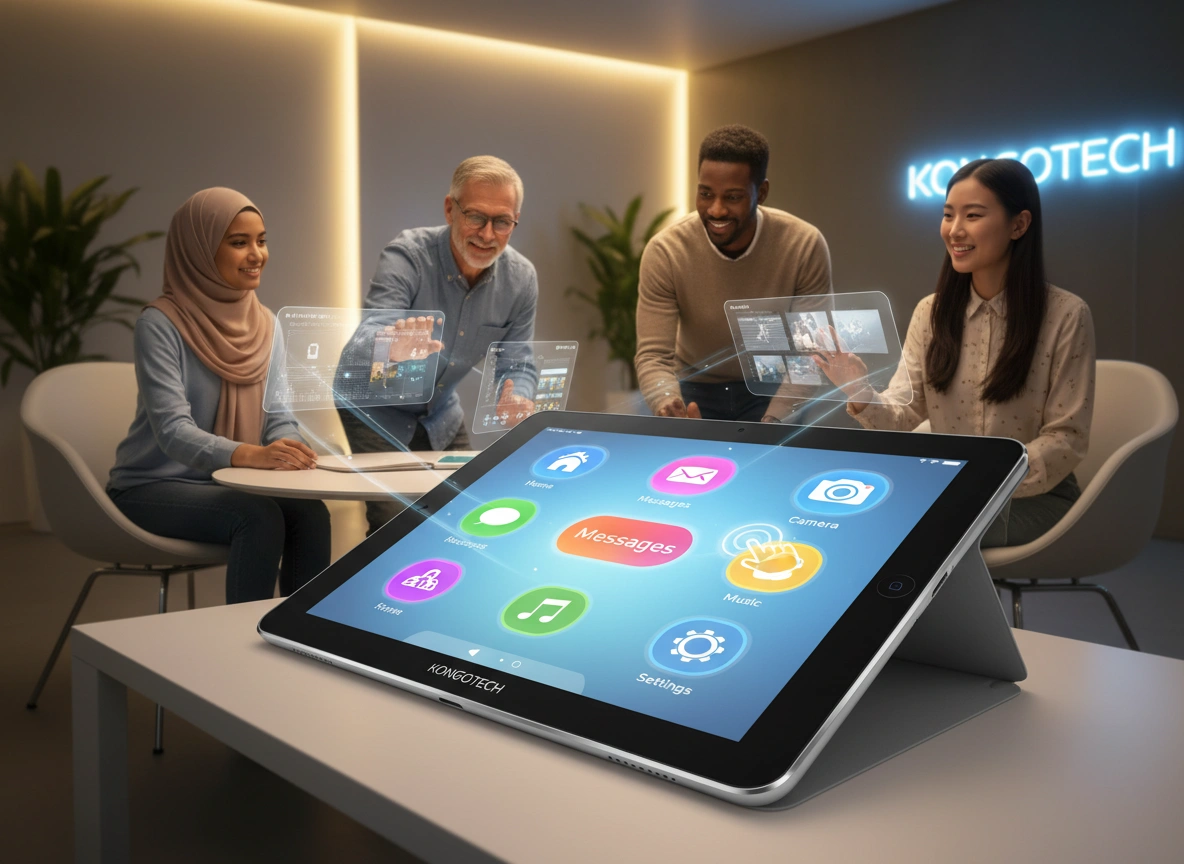
Technology should work for people, not the other way around. Yet, for decades, users have battled clunky interfaces, confusing manuals, and devices that seem designed for engineers rather than everyday humans. We have all experienced the frustration of setting up a new smart device only to be met with endless error codes, or trying to navigate software that requires a degree in computer science to understand.
This friction is exactly what Kongotech aims to eliminate.
In an industry often obsessed with “more”—more features, more specs, more complexity—Kongotech has carved out a unique position by focusing on “less.” Less confusion. Less friction. Less time spent troubleshooting. By prioritizing intuitive design and accessibility, the company is reshaping how we interact with the digital world. This article explores the specific strategies, innovations, and philosophies Kongotech uses to democratize technology and make it accessible to everyone.
The Philosophy of “Invisible Tech”
At the heart of Kongotech’s success lies a core philosophy often referred to as “Invisible Tech.” The premise is simple: the best technology is the kind you don’t notice. It operates in the background, facilitating your life without demanding your constant attention.
Most tech companies build a product and then try to figure out how to make it usable. Kongotech flips this script. Their development process begins with the user experience (UX) research phase, long before a single line of code is written or a circuit board is soldered. They study human behavior in natural environments—homes, offices, and transit—to identify pain points in existing technological interactions.
This anthropological approach leads to products that feel familiar the first time you pick them up. It isn’t about dumbing down technology; it is about smartening up the design. By removing unnecessary steps and automating complex processes, Kongotech allows users to focus on the result, not the tool.
User-Centric Design: Beyond the Buzzword
“User-centric” is a term thrown around in almost every tech keynote, but few companies embody it as thoroughly as Kongotech. Their design language is built on three pillars: Consistency, Clarity, and Feedback.
Consistency Across Ecosystems
One of the biggest hurdles in modern tech is the fragmentation of interfaces. Your phone works one way, your laptop another, and your smart fridge a third way entirely. Kongotech has unified its design language across all hardware and software. Whether a user is adjusting the thermostat on a Kongotech SmartHub or editing a document on a Kongotech Slate, the icons, gestures, and logic remain identical. This reduces the cognitive load on the user, as learning one device means essentially learning them all.
Clarity in Visual Hierarchy
Kongotech interfaces are famous for their minimalism. However, this isn’t just an aesthetic choice; it is a functional one. They utilize a strict visual hierarchy that guides the user’s eye to the most important functions immediately. Critical actions are prominent and distinct, while secondary options are tucked away until needed. This prevents “dashboard fatigue,” where a user is overwhelmed by too many buttons and dials clamoring for attention.
Immediate and Human Feedback
When you interact with a Kongotech device, it responds in a way that feels organic. Haptic feedback is subtle but affirmative. Visual cues are gentle. If an error occurs, the system doesn’t just flash a cryptic code like “Error 404.” Instead, it uses natural language processing to explain the problem simply: “We couldn’t connect to your Wi-Fi because the signal is weak. Try moving closer to the router.” This shift from technical jargon to conversational guidance transforms a potentially stressful moment into a manageable one.
Revolutionizing Accessibility Features
True user-friendliness means being friendly to all users, including those with disabilities. For too long, accessibility was an afterthought in the tech industry—a patch applied at the end of development. Kongotech treats accessibility as a foundational element of innovation.
The Voice-First Initiative
While voice assistants are common, Kongotech’s “Voice-First” initiative goes deeper. Their interface is designed to be fully navigable by voice alone, not just for simple queries but for complex system management. This is a game-changer for users with motor impairments who may struggle with touchscreens or keyboards. The natural language processing engine understands context, accents, and even speech impediments better than industry standards, ensuring that technology is obedient to the user’s voice, regardless of how they speak.
Adaptive Display Technology
Visual impairments range from total blindness to color blindness and light sensitivity. Kongotech’s adaptive displays automatically adjust contrast and text size based on the user’s proximity and the ambient lighting. For color-blind users, the operating system doesn’t just apply a filter; it re-maps the color coding of the entire UI to ensure that red and green warnings are distinct and distinguishable. This dynamic adjustment ensures that the screen is legible for everyone, reducing eye strain and confusion.
Tactile Innovation
For hardware, Kongotech has introduced modular tactile overlays. These are thin, transparent skins that can be applied to touchscreens to provide physical bumps and ridges over key buttons. This allows visually impaired users to feel the interface, bridging the gap between flat glass screens and physical controls. It is a simple, low-tech solution to a high-tech problem, perfectly illustrating their practical approach to inclusivity.
Reimagining Customer Support
Even the most intuitive technology occasionally requires help. Historically, customer support is the most dreaded aspect of the user experience. Kongotech has turned this liability into an asset through their “Proactive Support” model.
AI-Driven Anticipation
Kongotech devices come equipped with diagnostic AI that monitors system health. Often, the device knows it has a problem before the user does. If a battery is degrading or a software conflict is detected, the system sends a proactive notification: “I noticed your battery is draining faster than usual. Would you like me to run a diagnostic?” This prevents the user from being blindsided by a failure at a critical moment.
The “Human-in-the-Loop” Guarantee
While AI handles the basics, Kongotech guarantees that users can reach a human within two minutes if the AI cannot solve the issue. They have moved away from scripted call centers. Their support staff are trained as “Tech Concierges” with the authority to solve problems without escalating to a manager. This empowerment resolves issues faster and leaves customers feeling heard rather than processed.
Community-Powered Knowledge Base
Recognizing that users often learn best from each other, Kongotech curates a highly active, gamified community forum. Unlike standard forums filled with unanswered questions, Kongotech engineers actively participate in discussions. They also reward power users who create helpful tutorials or solve other users’ problems with discounts and early access to products. This creates a self-sustaining ecosystem of support where help is always available.
Privacy as a User Experience Feature
In the modern era, “user-friendly” also means “safe.” A device cannot be friendly if it is spying on you. Kongotech has made privacy a visible, controllable part of the user experience, rather than burying it in a 50-page Terms of Service agreement.
Their “Privacy Dashboard” is front and center in the settings menu. It shows exactly which apps have accessed data in the last 24 hours. More importantly, it features a literal “Kill Switch” for sensors. With one toggle, a user can hardware-disconnect the microphone and camera. This physical reassurance builds trust. When users feel safe, they are more willing to explore and utilize the technology to its fullest potential.
Breaking the Learning Curve with “Onboarding 2.0”
The first hour with a new device usually defines the relationship. Kongotech’s onboarding process is designed to be educational without being boring. instead of a paper manual, new devices launch an interactive, gamified tutorial.
Users learn gestures by actually performing them to solve small puzzles on the screen. They set up their preferences by answering conversational questions (“Do you like your screen bright or warm?” rather than “Set brightness to 70%”). This “learn by doing” approach ensures that by the time the setup is complete, the user is already an expert in the basic functions of the device.
The Ripple Effect on the Industry
Kongotech’s success has forced competitors to re-evaluate their own strategies. We are seeing a shift across the tech sector where specifications wars are being replaced by usability wars. Companies are realizing that a processor that is 10% faster matters less to the consumer than an interface that is 50% easier to use.
By proving that accessibility and simplicity are profitable, Kongotech is raising the bar for everyone. They have demonstrated that high-tech does not have to mean high-complexity.
Conclusion
Making technology user-friendly is not about a single feature or a sleek coat of paint. It is a holistic discipline that permeates every level of Kongotech’s operation, from the initial sketch to the customer support call five years later.
By focusing on invisible tech, enforcing consistent design, championing accessibility, and reimagining support, Kongotech is doing more than just selling gadgets. They are empowering people. They are removing the barriers between human intent and digital action, ensuring that technology serves as a bridge to our goals, not a hurdle we have to jump over. As we look to the future, Kongotech’s model suggests a world where technology is powerful, ubiquitous, and wonderfully, refreshingly simple.
